
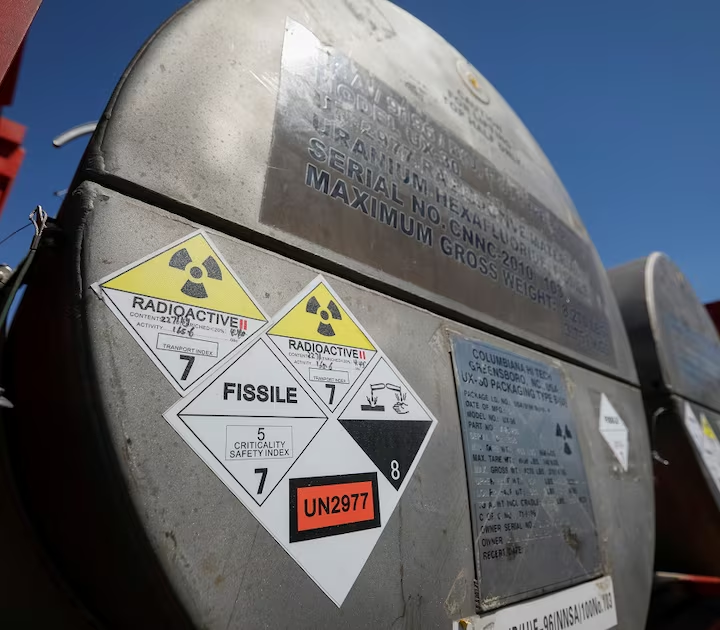
HALEU (High-Assay Low-Enriched Uranium) has long been the fuel of choice for small modular reactor developers, including TerraPower, X-energy and Oklo, because it allows for smaller designs and longer refueling cycles, but the lack of a U.S. supply chain could prevent them from deploying large fleets of reactors in the 2030s.
In contrast, GE Hitachi, Westinghouse, and Aalo Atomics have chosen Low Enriched Uranium Plus (LEU+), which could be provided by existing domestic facilities. Holtec’s SMR-300 is designed to support both LEU, the standard fuel used by nuclear reactors, and LEU+, which has a higher concentration of uranium-235, at between 5% and 10%.
Aalo Atomics opted for LEU+ because a domestic supply chain for HALEU “does not exist,” said the company’s Chief Technology Officer, Yasir Arafat.
“We know we want to get to market fast, and we know we need to scale up, to build hundreds of reactors, and we can’t do that with HALEU for many years, because the U.S. is still pumping money into that HALEU machine, trying to figure out how to crack the code,” Arafat told Reuters Events.
In a bid to prevent future shortages, the Trump administration in January announced $1.8 billion in funding to help American Centrifuge Operating (a Centrus Energy subsidiary) and General Matter create domestic enrichment capacity for HALEU.
CHART: Forecast US HALEU demand (MT)

Source: Idaho National Laboratory (INL) Purchase Licensing Rights, opens new tab
Arafat predicted that LEU+ reactors will have an edge over those running on HALEU “because we actually have a company that’s starting to make LEU+ here in the U.S.”
He was referring to Urenco USA, which received authorization from the U.S. Nuclear Regulatory Commission (NRC) to produce LEU+ at its Eunice, New Mexico facility last September. The facility began producing small quantities of LEU+ late last year and expects to reach commercial production in mid-2026.
Aalo has signed a supply chain agreement with Urenco for the LEU needed to power its Aalo-X experimental reactor, which is being built on an expedited timeline thanks to the Department of Energy (DOE) Reactor Pilot Program. However, the company’s future commercial reactor, the Aalo Pod, which is expected to start operations by 2029, will run on LEU+.
Almost all of the 94 commercial reactors producing power in the U.S. run on LEU fuel, which is enriched to between 3% and 5% of uranium-235. HALEU manufacturing sites have to be built from scratch, but facilities that produce LEU fuel can potentially be upgraded to produce LEU+, noted Patrick O’Brien, Director, Government Affairs and Communications Holtec International.
“LEU+ production can more efficiently leverage existing centrifuge infrastructure and Urenco has been authorized to produce it with first deliveries to fuel fabricators expected this year. To that end, LEU+ plants would likely have a faster deployment time in the short to medium term,” O’Brien said.
Join us at Reuters Events SMR & Advanced Reactor 2026 and network with over 700 utilities, developers, financiers, technology suppliers and regulators.
In addition, Westinghouse is working through the NRC regulatory process to start full-scale handling and fabrication of LEU+ production at its Columbia Fuel Fabrication Facility (CFFF) in South Carolina in 2028.
Westinghouse told Reuters Events that LEU+ reactors will have a supply chain advantage over those running on HALEU because “the NRC has already provided approval for LEU+ fuel designs, LEU+ fuel manufacturing and LEU+ fuel transportation for some enrichers and fuel vendors.”
CFFF last year assembled a first batch of LEU+ with pellets that were produced at a Westinghouse facility in the UK. The company in April 2025 supplied the LEU+ to the Vogtle Unit 2 in Georgia, which is currently testing the fuel.
The HALEU challenge
Approximately 90% of U.S. advanced reactor developers have chosen HALEU, which is enriched between 10% and 20%. Because HALEU has a much higher concentration of uranium, SMRs using it will be able to run for many years without stopping to be refueled.
“Higher enrichment enables longer operating cycles and helps reduce nuclear plant operating costs by decreasing the frequency of refueling outages,” said Erik Cothron, a senior analyst for the Nuclear Innovation Alliance.
For exclusive nuclear insights, sign up to our newsletter.
However, HALEU fuel is in extremely short supply. U.S. demand for HALEU could reach 50 metric tons per year by 2035, with additional amounts required each year, according to DOE. Centrus Energy is currently the only U.S. maker of the fuel and has the capacity to produce 1 metric ton per year.
In addition, each of the different HALEU reactors may need its own separate fuel fabrication plant to meet the unique requirements of the design.
CHART: US production of uranium concentrate

* In million pounds of Triuranium Octoxide. Source: U.S. Energy Information Administration. Purchase Licensing Rights, opens new tab
Overall, HALEU fuels will “cost more to produce because more separative work is needed to enrich them, and enrichment facilities are subject to more stringent regulations,” Cothron said.
“While supply risks imply a potential bottleneck for advanced reactor deployment, these higher-assay fuels offer meaningful competitive advantages because they enable the compactness, cycle length, and fuel performance that reactor developers like Oklo are aiming for,” said Bonita Chester, Head of Communications and Media at Oklo.
Oklo has secured a supply of HALEU from DOE for the company’s first commercial-scale reactor, the Aurora-INL, and is developing an advanced fuel recycling facility in Oak Ridge, Tennessee as part of its strategy to build a domestic fuel supply for future deployments. The facility is expected to begin production of advanced fuels by the early 2030s, Chester said.
“Oklo has a signed a memorandum of understanding with Centrus to examine advanced nuclear fuel services in Ohio and is also collaborating with Hexium to expand the commercial HALEU supply,” Chester added.
Download our exclusive report on accelerated US SMR prototypes.
LEU+ and HALEU have their advantages and disadvantages, according to Magnus Mori, Head of Advanced Fuels at Urenco.
“We don’t see one as being more advantageous than the other but instead think that the customer must align the fuel being used with the market they want to serve with their reactor design,” Mori told Reuters Events.
However, Mori conceded that LEU+ fuel will likely be more readily available in the short term because “the market for LEU+ is substantially larger at the moment since it could be used in many of the commercial reactors operating today around the world.”
Source: Reuters