
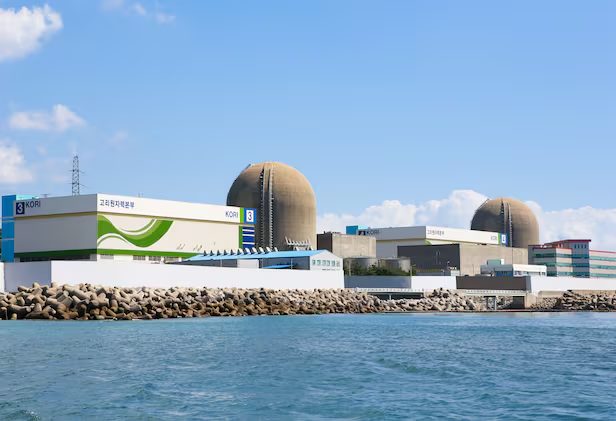
Kori nuclear reactors No. 3 and 4. /Courtesy of Korea Hydro & Nuclear Power
Korean utilities negotiate shift to fixed-price nuclear power trading
Korea Electric Power Corporation and Korea Hydro & Nuclear Power Co. (KHNP) are preparing to sign a contract to buy and sell electricity generated at nuclear power plants at a predetermined price. Currently, KEPCO uses the wholesale electricity price, or system marginal price (SMP), which is linked to fuel costs at liquefied natural gas (LNG) power plants, to settle payments to electricity producers, including KHNP. But it is preparing to switch to trading nuclear-generated electricity at a fixed price.
KEPCO and KHNP are in final negotiations ahead of signing a “government-approved contract for difference” on the 19th, according to the government and the power industry on the 18th. Under such a contract, a government-determined volume of electricity is bought and sold at a set price.
The contract would allow KEPCO and KHNP to predict electricity purchase costs and sales revenue during its term. The two companies are reportedly negotiating over the generation volume and contract price that would benefit each of them.
Electricity KEPCO buys from KHNP accounts for a substantial share of the total, equivalent to 32.1% of all electricity in 2025 (547,163 GWh). The change in the electricity purchase contract between KEPCO and KHNP therefore has significant implications for the power market.
However, the electricity KEPCO purchased from KHNP was worth 13.8681 trillion won, or 19.1% of the total value of electricity transactions (72.5879 trillion won). Its share of transaction value is smaller than its share of the volume traded. That is because KEPCO applies a discount to the wholesale electricity price, which is determined by fuel costs at LNG power plants, when settling payments to KHNP. Nuclear fuel costs are lower than those for LNG.
The discount is determined by a settlement adjustment coefficient set each year-end by the Korea Power Exchange’s cost evaluation committee. According to data the exchange submitted to People Power Party lawmaker Na Kyung-won, the coefficient for light-water reactors, which account for the overwhelming majority of Korea’s nuclear power plants, changed each year: 0.6211 in 2025, 0.4289 in 2024 and 0.2900 in 2023. As a result, the settlement price for nuclear power changed to 79 won per kilowatt-hour (kWh) in 2025, 66.27 won in 2024 and 54.98 won in 2023. Under a government-approved contract for difference, however, the settlement price per kWh would be fixed.
KEPCO has never signed a government-approved contract for difference for a nuclear power plant. The only such contracts KEPCO has signed were for byproduct gas power plants in 2015. At the time, POSCO Energy and Hyundai Green Power operated their plants under government-approved contracts for difference through 2019 and 2020, respectively.
Under the Electric Utility Act, KEPCO can sign government-approved contracts for difference for plants with low generation costs, such as nuclear, coal and hydropower plants, in addition to byproduct gas plants. However, as of November this year, no power producer is supplying electricity under such a contract.
The government issued operating standards for government-approved contracts for difference in late September and decided to sign such contracts covering 30 nuclear reactors. The contracts for the 26 reactors in operation are scheduled to be signed on Dec. 1. Contracts for reactors under construction are scheduled to be signed when test operations begin.
The key issues in a government-approved contract for difference are the contract price and the volume of electricity generated. The contract price combines fuel costs with depreciation expenses reflecting nuclear plant construction costs and returns on investment, among other items. KEPCO and KHNP are reportedly in final negotiations over the level of investment returns.
An official at the Korea Power Exchange said, “Under the current settlement adjustment coefficient system, KHNP’s rate of return on investment and profits fluctuate each year depending on the profits of KEPCO’s power generation subsidiaries, including KHNP. But a government-approved contract for difference would set an appropriate rate of return for nuclear plants in advance, securing stable sales revenue and allowing KHNP to strengthen its financial health over the medium to long term.”
Kim Jin-su, a professor at Hanyang University, said, “A government-approved contract for difference is effectively a fixed-price contract. If the parties set a margin and a rate of return on investment and sign a contract for a set period, revenue is fixed in line with that rate, which is good for KHNP. It is also good for KEPCO because it can set the purchase volume and price.”
Once KEPCO and KHNP sign a government-approved contract for difference, it is expected to undergo review by the Electricity Regulatory Commission and approval by the Minister of Climate, Energy and Environment.
Source: Chosun Biz