
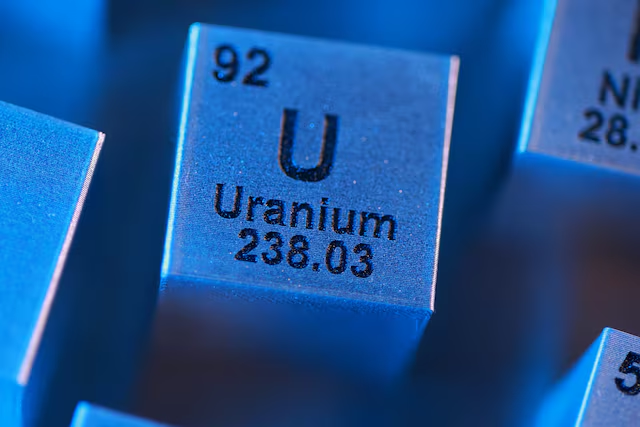
The United States is pressing suppliers to accelerate development of uranium enrichment capacity to avert potential shortages as interest in nuclear power grows, two United States Department of Energy officials told Reuters.
Multiple countries are seeking to expand nuclear power by building reactors or restarting mothballed power plants to meet rising electricity demand, largely caused by increased use of artificial intelligence.
The heightened interest has led uranium costs to almost triple over the last five years, according to industry consultancy UxC.
“Our objective is to solve as many of the bottlenecks and constraints as quickly as we can,” U.S. Deputy Secretary of Energy James Danly told Reuters at a nuclear conference in Paris, co-hosted by the US and the Paris-based Organisation for Economic Co-operation and Development.
“If we are going to have this nuclear renaissance, we are not going to be able to do it without fuel. We want to have as much domestic capacity as we can as quickly as we can,” Danly said.
FRANCE RELIES ON NUCLEAR POWER MORE THAN ANY OTHER COUNTRY
Nuclear power remains highly divisive. It can produce huge amounts of energy without adding planet-warming carbon emissions to the atmosphere, but it generates difficult-to-manage waste and tends to be extremely expensive.
In Europe, the extreme heat of this summer led to shutdowns because nuclear plants could not be cooled.
France relies on nuclear power for about 70% of its electricity supply, the highest proportion in the world. According to figures from the World Nuclear Association, part of the OECD, the US is the largest producer of nuclear energy, but it only supplies 18% of the country’s electricity.
The last commercial nuclear plant to open in the U.S. came online in 2024 and was delayed by years and billions over budget. The U.S. has plans to restart three nuclear plants that had been shut but none of those are online yet.
Uranium for large conventional reactors is enriched to a lower level than is needed to create weapons.
Washington is urging the companies who enrich the uranium to fuel nuclear plants, including Orano of France, and US companies, Centrus and General Matter, to develop enrichment capacity as quickly as possible, said Michael Goff, US principal deputy assistant secretary at the Department of Energy.
One incentive is the use of milestone-based contracts. Around $900 million in government awards for new facilities is tied to companies meeting development deadlines, Goff said.
“One of the key things, though, that we also did to make it an environment where these companies will invest is we had to make sure that Russia’s not going to be able to get back into the fuel services in our country,” Goff said.
Since Russia started its war on Ukraine in 2022, the United States has banned imports of Russian-enriched uranium, although companies can obtain temporary waivers to avoid supply shortages.
The waiver system expires at the start of 2028, and Goff said there were no plans to extend it.
Source: Reuters