
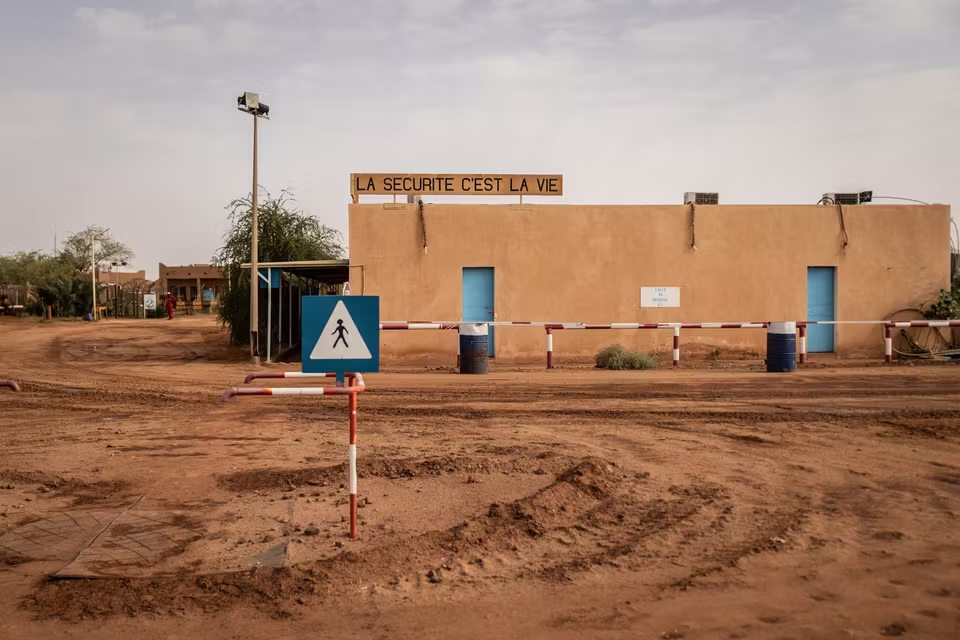
Nigerien authorities are seeking to sell yellowcake uranium stockpiled at the Arlit site, formerly operated by the French company Orano, which was forced to halt its activities following the 2023 coup d’état.
Hundreds of metric tons of uranium are being loaded onto trucks crossing regions controlled by jihadist groups affiliated with Al-Qaeda and the Islamic State group. According to multiple French government sources, this high-risk operation is currently under consideration by Russian and Nigerien authorities. The Elysée has been informed, and the matter is raising concern among leaders in Paris.
French officials said they are convinced that a deal was recently reached for $170 million between the junta led by General Abdourahamane Tiani and the Russian nuclear giant Rosatom for the acquisition of 1,000 metric tons of yellowcake (concentrated but unenriched uranium) produced by French nuclear group Orano at its former Arlit mine in northern Niger, where some 1,400 metric tons are stored.
According to a senior French security source, both parties are now working to set up a convoy of around 30 trucks to transport the uranium via Burkina Faso to the port of Lomé, Togo by the end of November. From there, it would be shipped to Russia by cargo vessel.
The source added that Nigerien military, customs and intelligence officials held talks in October with their Burkinabé and Togolese counterparts to secure their cooperation – an essential step for such a perilous convoy.
Nigerien denial
If carried out, this convoy project would be highly risky. The planned route would pass through northern and eastern Burkina Faso, large parts of which are under the sway of the Jama’at Nusrat ul-Islam wa al-Muslimin (the Sahel branch of Al-Qaeda) or the Islamic State group in the Sahel.
Confirming knowledge of this proposed sale from Niger to Moscow, a French industry official has questioned how far the plan has progressed. He added that Rosatom currently has no need for this resource to supply its own activities. If the sale were to proceed, he said, it could be the result of pressure from the Russian authorities seeking to assist their Nigerien ally, which faces severe financial hardship.
A Nigerien government source, however, has denied any agreement for the sale of these 1,000 metric tons of yellowcake, as well as any plan to transport such a shipment to Togo. “We have not signed anything with Rosatom. For now, we have not sold a single gram of uranium to anyone. And we will never risk sending yellowcake on roads through unsecured areas,” the source insisted.
“Rosatom is not party to the agreement mentioned,” the Russian company replied. However, this does not exclude the involvement of a third-party company, as cited by French sources. “There is currently no activity” on the ground at the Arlit mine, added a local source.
Nationalization of the local subsidiary
Following the 2023 coup, General Tiani’s junta expelled French troops from Niger and abruptly turned away from its former colonial power, seeking new partners, including Russia.
Orano (formerly Areva) – more than 90% owned by the French state and present in Niger since 1971 – was gradually forced to cease operations, fueling a deeply strained relationship between the two countries. It was a significant blow: Between 2012 and 2022, 20% of the 88,200 metric tons of natural uranium imported to keep France’s nuclear power plants running came from Niger.
After announcing in December 2024 that it had “lost operational control,” Orano’s local subsidiary, Somaïr, which mines uranium at Arlit, was nationalized by Nigerien authorities on June 19.
The French company has initiated arbitration proceedings against the Nigerien state at the International Centre for Settlement of Investment Disputes (ICSID), a World Bank organization based in Washington, to assert its rights.
Roughly €250 million
At the heart of the dispute between Orano and Niger are some 1,400 metric tons of yellowcake still stored at Arlit, with a market value of about €250 million. Each side claims ownership of the stockpile.
Asked by Le Monde about the possible sale of the bulk of this stock to Rosatom, Orano responded that it was no longer “in a position to comment on the activities of Somaïr since losing control of its operations” in the country.
The French nuclear group also noted that “the ICSID tribunal issued a new ruling in [its] favor on September 23, ordering the State of Niger not to sell, transfer or even facilitate the transfer to third parties of uranium produced by Somaïr.”
Four days later, in an address to the United Nations General Assembly, Nigerien Prime Minister Ali Mahamane Lamine Zeine accused France of “dragging [his country] into endless lawsuits to halt the mining and sale” of its uranium ore.
Advanced negotiations with Russia
Since 2024, Nigerien authorities who face financial difficulties have sought to sell the uranium stockpile at Arlit. Iran and China expressed interest, but negotiations moved furthest with Russia. On July 28, Rosatom and Niger’s energy ministry signed “a memorandum of mutual understanding” on cooperation in the civilian nuclear sector.
Contacted by Le Monde, the International Atomic Energy Agency (IAEA) declined to comment on the issue. Its director general, Rafael Grossi, visited Niger on March 12, including a stop at the Arlit mine. Although he cited his desire to welcome “transparency and cooperation,” the trip was mainly devoted to the future of Somaïr’s 1,400 metric tons of uranium stock and to the question of a potential buyer.