
A sizeable nuclear industry contingent is set to accompany Russian President Vladimir Putin during his upcoming India visit. Here’s what Russia is offering, and what India needs.
Russian nuclear company Rosatom State Corporation is likely to make a strong pitch for deploying its small modular reactors (SMR) for targeted applications in India, alongside efforts to position its large new-generation atomic power reactor-based projects as the cornerstone of the bilateral cooperation between the two countries in the field of nuclear energy.
A sizeable nuclear industry contingent is to accompany Russian President Vladimir Putin during his India visit and bilateral talks are expected to build on the working meeting that took place in Mumbai on November 10 between Ajit Kumar Mohanty, Chairman of India’s Department of Atomic Energy, and Alexey Likhachev, Director General of Rosatom, a Russian state corporation based in Moscow that specialises in nuclear energy and nuclear non-energy products.
Russia’s SMR pitch
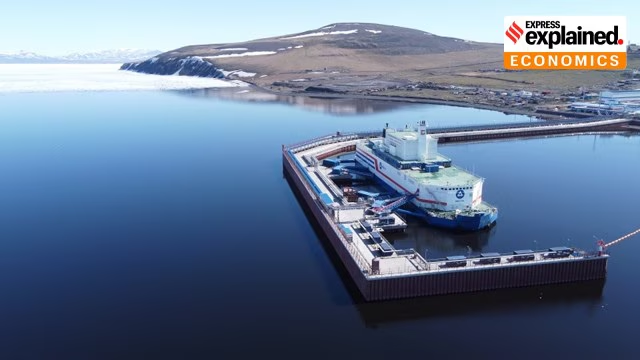
Russia has a lead in the nascent field of SMRs, which are advanced nuclear reactors that have about a third of the generating capacity of most traditional nuclear power reactors but can produce a large amount of low-carbon electricity. Currently, two SMR projects have reached the operational stage globally, with an SMR named the ‘Akademik Lomonosov floating power unit’ that has two-modules of 35 MWe (megawatt electric) and started commercial operation in May 2020. The Lomonosov is a non-self-propelled power barge that doubles up as a floating nuclear power station and is docked in the Pevek harbour, providing heating for the Arctic port town of Pevek and supplying electricity to the regional Chaun-Bilibino power system. It is designated as the world’s northernmost nuclear power plant.
The other operational SMR is a demonstration project called HTR-PM in China that was grid-connected in December 2021 and is reported to have started commercial operations in December 2023. Other global companies that are in the fray for SMR leadership include New Jersey-based Holtec International, Rolls-Royce SMR, NuScale’s VOYGR SMR, Westinghouse Electric’s AP300 SMR and GE-Hitachi’s BWRX-300.
Kudankulam project expansion
During the November meeting, the two sides reviewed the progress of the Kudankulam nuclear power project (KKNPP) in Tamil Nadu, the largest nuclear power station in India and the flagship project of the Russia-India energy cooperation. KKNPP Units 1 and 2, where Russia’s earlier generation ‘VVER-1000’ reactor units have been deployed, were connected to the national power grid in 2013 and 2016 respectively and currently supply electricity to India’s southern region. At Unit 3, pre-commissioning activities are on, with preparations underway for key milestones – testing of safety systems on an open reactor. Also, construction and installation work and equipment deliveries continue at Unit 4, and the third phase – Units 5 and 6 – are actively under construction. The project provides for the construction of six power units with ‘VVER-1000’ reactors and a total installed capacity of 6000 MWe.
One of the key negotiating points for Moscow is the promise of serial construction of high-capacity nuclear power units of Russian design in India, based on the new-gen ‘VVER-1200’ reactor models. Technical specifications for a new nuclear power plant in India featuring ‘VVER-1200’ reactor units are being proposed by the Russian side, government officials indicated. There is a possibility that fresh big-ticket deals might not be inked right away, given that a delegation from the US is coming next week to explore the possibility of taking forward the bilateral trade deal.
The upcoming discussions are likely to cover the expansion of this partnership, including the development of projects for both large and small-scale nuclear power plants and cooperation in the nuclear fuel cycle. Opportunities for localising equipment production in India, in keeping with the government’s Make-in-India push, is on the cards. Utilities such as the Rail Vikas Nigam Ltd (RVNL), a public sector undertaking of the Ministry of Railways, are already in discussion with Rosatom to deploy SMRs to meet the energy requirements of its four ongoing rail projects, including the Rishikesh-Karnaprayag line.
Floating N-power proposal
The new area of cooperation that is under discussion includes the construction of SMRs of Russian design in India. In April 2024, Rosatom had presented its Indian partners with information on the corporation’s floating nuclear power solutions. Russia is the only country in the world with expertise in this field.
SMR technologies are aimed at supplying clean electricity to remote regions with limited grid infrastructure, as well as to individual industrial enterprises. India is looking at SMRs as a solution for localised applications, such as energy-hungry data centres, and quick scaling up of base load capacity.
Rosatom’s fuel company TVEL already supplies India with nuclear fuel TVC-2M, which offers new capabilities for Kudankulam NPP – allowing the station to operate under an 18-month fuel cycle, thereby significantly improving the economic efficiency of the power units compared with the traditional 12-month cycle.
India’s baseload pursuit: Nuclear energy
In the civil nuclear sector, New Delhi is now pushing SMRs as a technology of promise that can help in industrial decarbonisation, including a determined hard sell of the country’s ability to take something of a leadership role in the dissemination of this technology. These are important in offering base load power that could give grid operators some degree of flexibility, especially given the imperative of inducting large-scale renewables into the grid that brings with it the accompanying challenge of ramping up base load generation to balance out the vagaries of renewable power output. While thermal generation is seen as important in this regard, nuclear energy offers a more carbon-neutral base load generation option.
India currently has 24 operational nuclear reactors totalling 7,943 MWe of capacity, with six reactors – 4,768 MWe – under construction. Another 10 units – some 7 GWe of capacity – are in pre-project stages. The Centre has a target to expand its nuclear energy capacity to 100 GWe by 2047, for which it plans to pursue a two-pronged approach: the deployment of large-capacity reactors as well as the use of SMRs to ensure faster deployment of units.
The government has allocated more than $2 billion for research and development on SMRs with a plan for at least five indigenously designed and operational SMRs by 2033. To encourage active participation of the private sector in this transformative initiative, the government is also creating an enabling legal framework in the nuclear sector and moving the Atomic Energy Bill, 2025, which is one of two key amendments being readied to overhaul a couple of overarching legislations governing the country’s atomic energy sector.
The amendment aims at tweaking the Atomic Energy Act, 1962 to enable private companies to enter nuclear power plant operations in India to potentially take a minority equity exposure of up to 49 per cent in upcoming nuclear power projects, while also setting the stage for foreign companies to infuse equity into these projects to scale up the execution pace. Hitherto, atomic energy has been one of India’s most closed sectors.
Source: Indian Express